Affiliate marketing is one of the most popular ways to earn income online. But here’s the problem most beginners run into: they spend weeks creating content, building funnels, and driving traffic — without ever calculating whether the commission rate actually makes their effort worthwhile.
An affiliate commission calculator solves that instantly. Enter your sale amount and commission rate, and you’ll know your exact earnings in seconds.
This page is built for bloggers, content creators, freelancers, and marketers who want to choose affiliate programs smarter and set realistic income goals.
What Is a Affiliate Commission Calculator (Free & Easy)?
An affiliate commission calculator is a tool that tells you exactly how much money you’ll earn from an affiliate sale, based on two inputs: the sale price and your commission rate.
When you join an affiliate program, the company agrees to pay you a percentage of every sale you refer. That percentage is your commission rate. Multiply it by the sale price and you have your affiliate commission.
Affiliates and businesses use this calculation to:
- Estimate realistic earnings before promoting a product
- Compare affiliate programs side by side
- Set monthly income goals and work out how many sales are needed
- Build marketing budgets based on actual projected returns
Formula
The math is simple. Here’s the formula used by this calculator:
Affiliate Commission = Sale Price × (Commission Rate ÷ 100)

Total Earnings = Commission Per Sale × Number of Sales
Example Calculation
Let’s walk through a real example so you can see exactly how this works in practice.
Scenario: You’re promoting an online course priced at $200 through an affiliate program that pays 30% commission.
| Product Price | $200 |
| Commission Rate | 30% |
| Commission Per Sale | $200 × 0.30 = $60 |
| Number of Sales This Month | 10 |
| Total Monthly Earnings | $600 |
What Is a Good Result?
The right commission rate depends entirely on the product type. A 5% commission on a $50 item is very different from a 5% commission on a $5,000 software package. Always evaluate the rate alongside the product price.
| Product type | Typical rate | Rating |
|---|---|---|
| Physical products (retail, eCommerce) | 1%–10% | Low |
| Digital products (courses, ebooks) | 20%–50% | High |
| SaaS & software subscriptions | 20%–40% recurring | High |
| Finance & insurance | 10%–30% | Good |
| Web hosting | $50–$200 flat fee | High |
| Fashion & lifestyle | 5%–20% | Average |
Amazon Affiliate Commission Calculator
Amazon Associates is the world’s largest affiliate program — and one of the most misunderstood. Most affiliates assume commissions are uniform. They’re not. The category your linked product falls into determines your rate, and the gap between the highest and lowest paying categories is enormous.
Use the calculator above with the rates below to project your Amazon affiliate earnings before you build content around any category.
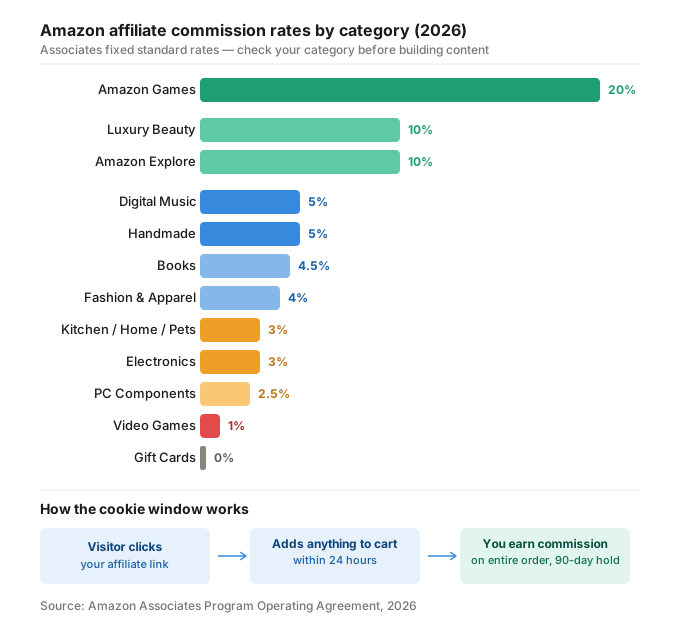
Amazon Affiliate Commission Rates by Category (2026)
| Category | Commission Rate | Notes |
|---|---|---|
| Amazon Games | 20% | Highest rate available |
| Luxury Beauty | 10% | High-value purchases, strong per-sale earnings |
| Amazon Explore | 10% | Experiences and virtual activities |
| Digital Music / Physical Music | 5% | Consistent performer |
| Handmade Products | 5% | Growing category |
| Books | 4.5% | High purchase intent, strong for content sites |
| Fashion, Apparel, Shoes | 4% | High volume, decent rate |
| Kitchen, Home, Pets, Sports | 3% | Popular but lower rate |
| PC Components | 2.5% | High average order value offsets lower rate |
| Electronics | 3% | Lower rate but high average order values |
| Video Games / Consoles | 1% | Low rate — factor into content decisions |
| Gift Cards | 0% | No commission paid |
Key insight: A $300 laptop at 3% earns $9. The same $300 sale in Luxury Beauty at 10% earns $30. Always check the category rate before committing your content strategy to a product.
How Amazon’s 24-Hour Cookie Window Works
When someone clicks your affiliate link, Amazon credits you for any product they add to their cart within 24 hours — not just the product you linked. If they add a $500 camera, a tripod, and a memory card, you earn commission on all of it. Once an item is in the cart, Amazon holds the referral for 90 days.
This cart-wide commission model makes Amazon’s headline rates more valuable than they appear on paper.
Amazon Affiliate Commission Example
You run a books and productivity blog. A reader clicks your affiliate link to a $25 book and while on Amazon also adds a $60 desk organiser to their cart.
| Item | Price | Category | Rate | Commission |
|---|---|---|---|---|
| Book | $25 | Books | 4.5% | $1.13 |
| Desk organiser | $60 | Home | 3% | $1.80 |
| Total earned | $85 | — | — | $2.93 |
One click, two commissions. At scale — 500 clicks/month with a 5% conversion rate — that’s 25 orders averaging $2.93 each: $73/month from a single content piece.
How to Improve Your Affiliate Commission Results
Knowing your commission rate is step one. Growing it is step two. Here are six practical ways to earn more without necessarily driving more traffic:
Promote High-Ticket Products
A 20% rate on a $500 product earns $100 per sale. The same rate on a $20 product earns $4. Same effort — very different payoff. Always check the absolute dollar value, not just the percentage.
Target the Right Audience
Promoting to people who already want the product dramatically increases conversions. Match the offer to your audience’s actual needs and buying intent — not just your own interest.
Create Better Content
Detailed reviews, tutorials, and comparison articles outperform generic promotions. **Helpful content builds trust** and converts browsers into buyers far more consistently.
Optimise Your Landing Pages
Slow pages, confusing layouts, and weak calls-to-action kill conversions. Even small improvements — like a clearer headline or a faster load time — can lift earnings noticeably.
Negotiate a Better Rate
Once you’re driving consistent sales, **contact the merchant directly**. Top affiliates routinely secure custom rates that aren’t listed publicly — especially after 3–6 months of proven performance.
Build an Email List
An email list lets you promote offers repeatedly to warm subscribers. One quality list can generate affiliate commissions from the same audience for years, making it one of the **highest-ROI** activities in affiliate marketing.
Common Mistakes When Calculating Affiliate Commission
These errors are extremely common — especially among beginners. Avoiding them now will save you a lot of frustration later.
1
Ignoring refunds and cancellations
Most affiliate programs claw back commissions when customers request refunds. Your real net commission rate could be 5–15% lower than advertised. Always factor this into projections, especially for programs in high-refund categories like digital products and software.
2
Judging programs purely by commission rate
A 50% commission sounds great — until the product costs $10. That’s $5 per sale. Always calculate the actual dollar amount earned per conversion before deciding whether a program deserves your time and content.
3
Not tracking real conversion data
Projections are just estimates. Your actual earnings depend on your real conversion rate, which you can only know by tracking. Use UTM parameters and your affiliate dashboard to measure what actually converts.
4
Forgetting marketing costs
Paid ads, tools, and content creation costs reduce your actual profit. A campaign earning $500 in commissions with $450 in ad spend has a very thin margin. Always calculate net earnings, not gross revenue.
5
Overestimating conversion rates
Industry-average conversion rates typically fall between 1% and 5%. Assuming most visitors will buy is the most common beginner mistake. Use conservative estimates in all projections and treat higher conversions as a bonus.
Frequently Asked Questions
1How do you calculate affiliate commission?
Multiply the sale amount by the commission rate. A $200 product with a 25% commission rate earns $50 per sale. For multiple sales, multiply the per-sale commission by your number of conversions. Use the calculator above to run these numbers instantly.
2What is a typical affiliate commission rate?
It depends on the product category:
– Physical products typically pay 1%–10%
– Digital products (courses, software) usually pay 20%–50%
– SaaS subscriptions often offer 20%–40% recurring commissions
Always check the specific program’s rate before projecting your earnings.
3What are Amazon affiliate commission rates in 2026?
Amazon affiliate commission rates in 2026 range from 0% to 20% depending on product category. The highest paying categories are Amazon Games (20%), Luxury Beauty (10%), and Amazon Explore (10%). Most physical product categories fall between 1% and 4.5%. Electronics pays 3%, Books 4.5%, and Video Games just 1%.
4Can affiliate commissions be recurring?
Yes. SaaS platforms, membership sites, and subscription services often pay affiliates a percentage every billing cycle for as long as the customer stays subscribed. One referred customer can generate commissions for months or years — making SaaS one of the highest long-term value affiliate categories.
Regular review helps you catch unprofitable campaigns early.
6Do all affiliate programs pay the same way?
No. Payout structures vary widely:
– **Percentage-based:** You earn a % of every sale
– **Flat fee:** A fixed amount per sale regardless of order value
– **Per lead (CPA):** You get paid when someone fills out a form
– **Recurring:** You earn every billing cycle the customer stays active
Always read the program terms carefully before promoting.
Start Calculating Your Commissions Today
Knowing your numbers is the difference between guessing and growing. Use the free affiliate commission calculator above to estimate your earnings, compare programs side by side, and set income goals backed by real data — not hope.
If you’re just starting out, even a rough calculation before you commit to promoting a product can save you weeks of wasted effort. Run the numbers first…